Uses of the Archives in Publication
Published Tributes
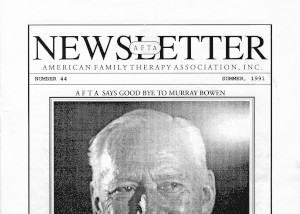
American Family Therapy Association, Inc. (AFTA) Newsletter
Thank you to The American Family Therapy Association for permission to reproduce and post the newsletter, and to Joanne Bowen for making the document available.
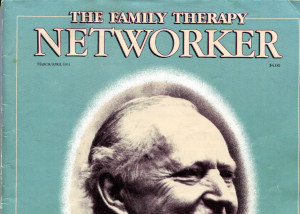
The Family Therapy Networker
Thank you to The American Association for Marriage and Family Therapy for permission to reproduce and post the newsletter, and to Joanne Bowen for making the document available.
Articles
This is a partial bibliography of articles and chapters that have drawn on the L. Murray Bowen Collection at NLM. If you are aware of others, please contact us with that information.
In the years since his death, several of Dr. Bowen’s unpublished papers, part of his archives, have been published in the Family Systems Journal.
Now Available Through The Archives
“Analyzing Two Months of the Observational Data from Bowen’s 1954-1959 NIMH Project: August 1955 and October 1956,” By Catherine Rakow
Rakow looks closely at two months of nursing notes and archival material from Bowen’s NIMH project to trace the patterns of interaction within families, especially between mothers and their impaired offspring, that informed the early development of Bowen theory. By working directly with the original observations, the article shows how the theory grew out of day-to-day interactions, while also shedding light on Bowen’s research approach and the complexity of the emotional processes unfolding in real time.
Rakow, C. M. (2013). Analyzing two months of the observational data from Bowen’s 1954–1959 NIMH project: August 1955 and October 1956. Family Systems Forum, 15(3).
“Learning from the Nurses’ Notes for Bowen’s 1954-1959 NIMH Project: A Window into the Development of Theory,” By Catherine Rakow
Looking closely at nursing notes from Bowen’s NIMH project, Rakow shows how small shifts in relationships, rather than just individual symptoms, helped shape early thinking about how families function. Focusing on one month of archival material, she highlights the important role nurses played in carefully recording what they saw and heard. These detailed observations offer a window into how recurring patterns in relationships were recognized and gradually contributed to the idea of the family as an emotional system.
Rakow, C. M. (2016). Learning from the nurses’ notes for Bowen’s 1954–1959 NIMH project: A window into the development of theory. Family Systems Forum, 11(2).
“Death as a Catalyst for Reconstructing the Family Emotional System: Bowen Family Systems Theory Perspectives,” By Catherine Rakow
In this chapter, Rakow examines how death can bring underlying relationship patterns within a family into clearer focus. She explores how loss may intensify existing dynamics, at times reinforcing familiar ways of relating and, at other times, opening the possibility for change. Drawing on Bowen theory, she traces how families reorganize in the aftermath of a death and how each individual’s level of differentiation shapes that process.
Rakow, C. M. (2018). Death as a catalyst for reconstructing the family emotional system. In P. Titelman & S. K. Reed (Eds.), Death and chronic illness in the family: Bowen family systems theory perspectives. Routledge.
“The Back Story on Developing the Concept of Differentiation, As Seen in the Murray Bowen Archives,” By Catherine Rakow
Looking back at early archival materials, Rakow traces how Dr. Bowen developed the concept of “differentiation of self” over time. Drawing on notes, papers, and later reflections, she shows how Bowen’s thinking evolved through close attention to clinical observations and a willingness to follow data, even when it challenged established psychoanalytic ideas. The chapter offers insight into the gradual formation of differentiation-of-self, one of the central concepts in Bowen theory, and highlights the value of the archives in understanding how the theory took shape.
Rakow, C. M. (2022). The back story on developing the concept of differentiation, as seen in the Murray Bowen Archives. Family Systems Journal, 16(2), 101–132.
“The Importance of the Murray Bowen Archives,” By Catherine Rakow
In this chapter, Rakow reflects on the significance of the Murray Bowen Archives for both scholarship and practice. She highlights how the archives preserve primary materials including letters, clinical records, notes, and recordings that reveal Bowen’s evolving thinking and development of the theory. By showing how these original sources provide insight into Bowen’s methods, assumptions, and conceptual changes over time, the chapter underscores the importance of archival preservation for deepening understanding of family systems theory and supporting future research.
Rakow, C. M. (2022). The importance of the Murray Bowen Archives. Family Systems Forum, 24(1).
Additional Articles
Bourne, G. Mary, compiler and ed. (2010). Misunderstandings from the Family Field. “A Training Session by Dr. Murray Bowen at the Minnesota Institute of Family Dynamics.” Bringing Systems Thinking to Life: Expanding the Horizons for Bowen Family Systems Theory. Ona Cohn Bregman and Charles M. White, Eds. New York and London: Routledge.
Bourne, G. Mary, compiler and ed. (2010). A Science of Human Behavior, “A Training Session by Dr. Murray Bowen at the Minnesota Institute of Family Dynamics.” Bringing Systems Thinking to Life: Expanding the Horizons for Bowen Family Systems Theory. Ona Cohn Bregman and Charles M. White, Eds. New York and London: Routledge.
Bourne, G. Mary, compiler and ed. (2010). Various Theoretical Points People Miss. “A Training Session by Dr. Murray Bowen at the Minnesota Institute of Family Dynamics.” Bringing Systems Thinking to Life: Expanding the Horizons for Bowen Family Systems Theory. Ona Cohn Bregman and Charles M. White, Eds. New York and London: Routledge.
Butler, John F., Ph.D. (2011). Bowen’s NIMH Family Study Project and the Origins of Family Psychotherapy. Family Systems Journal 8(2): 135-142.
Butler, John F., Ph.D (2013). Family Psychotherapy: The First Evolutionary Stage During the NIMH Family Study Project. Family Systems Journal 10(1): 29-42.
Dysinger, Robert H. M.D. (2003). The “Action Dialogue” in an Intense Relationship: The Study of a Schizophrenic Girl and her Mother. Family Systems Journal 6(2): 117-134.
Rakow, Catherine (1994). Bowen Archives in the NIMH Papers: A Personal Report. Family Center Report (A publication of the Georgetown Family Center) 15(3).
Rakow, Catherine (2013). Analyzing observational data from Bowen’s NIMH Project. Family Systems Forum 15(3).
Rakow, Catherine (2016). Learning from the Nurses’ Notes for Bowen’s 1954-1959 NIMH Project: A Window into the Development of Theory. Family Systems Forum 11(2).
Rakow, C. (2018). Chapter 8: “Death as a Catalyst for Reconstructing the Family Emotional System “, in Death and Chronic Illness in the Family: Bowen Family Systems Theory Perspectives by Peter Titelman (Editor), Sydney K. Reed (Editor); Routledge
Rakow, C. (2022). “The Back Story on Developing the Concept of Differentiation, As Seen in the Murray Bowen Archives”, Family Systems Journal, Volume 16, Number 2, pp. 101-132
Rakow, C. (2022). “The Importance of the Murray Bowen Archives”, Family Systems Forum, Vol. 24, No. 1, Spring 2022
Rakow, C. (2022). Making Sense of Human Life, Murray Bowen’s Determined Effort Toward Family Systems Theory. Routledge: New York
Dissertations
Baege, Monika (2005). Family Process Influences on the Resilient Responses of Youth, Ed.D. dissertation, University of Vermont.
Abstract
Weinstein, Deborah F. (2013). The Pathological Family: Postwar America and the Rise of Family Therapy. Ph.D. dissertation, Harvard University.
View through ProQuest